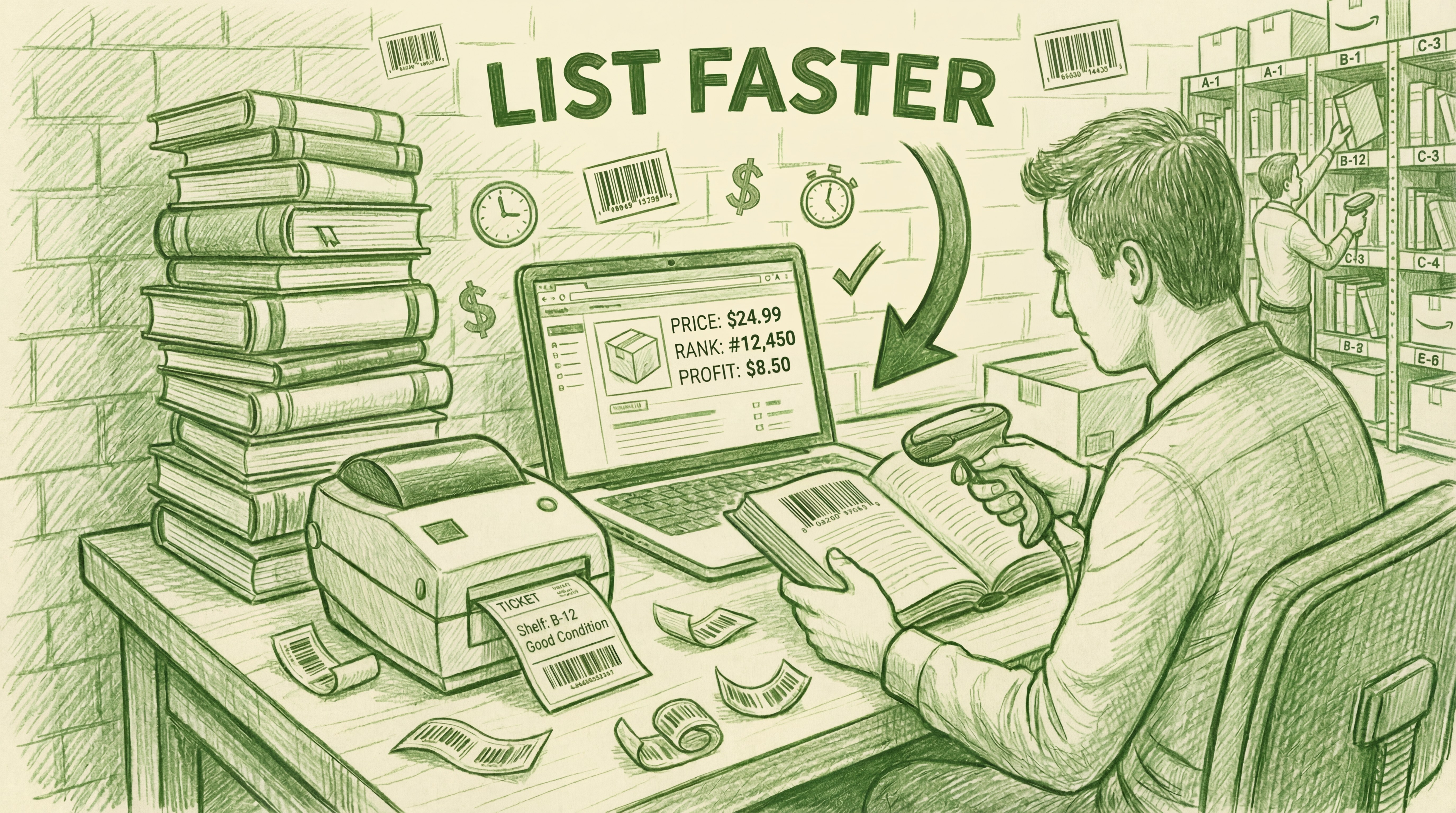
If you’re only selling on Amazon right now, your prices are probably lower than they should be. And you’re probably right to feel that way.
Caleb Roth’s Buy Box research laid this out clearly: Amazon’s algorithm changed dramatically in late 2025. FBA went from winning 85% of Buy Boxes to just 13%. Condition now matters more than fulfillment method. Price only determines about half of Buy Box wins. The old playbook of “be the cheapest FBA offer and win” is dead.
What replaced it is chaos. Nobody knows exactly how the Buy Box works anymore, so everyone is doing the same thing: racing to the bottom. You’re the 10th seller on a listing, someone undercuts by a penny, you match, someone else undercuts, and the price craters. That $25 book is now $12. Not because it’s worth $12 — but because 10 sellers are all panicking at each other.

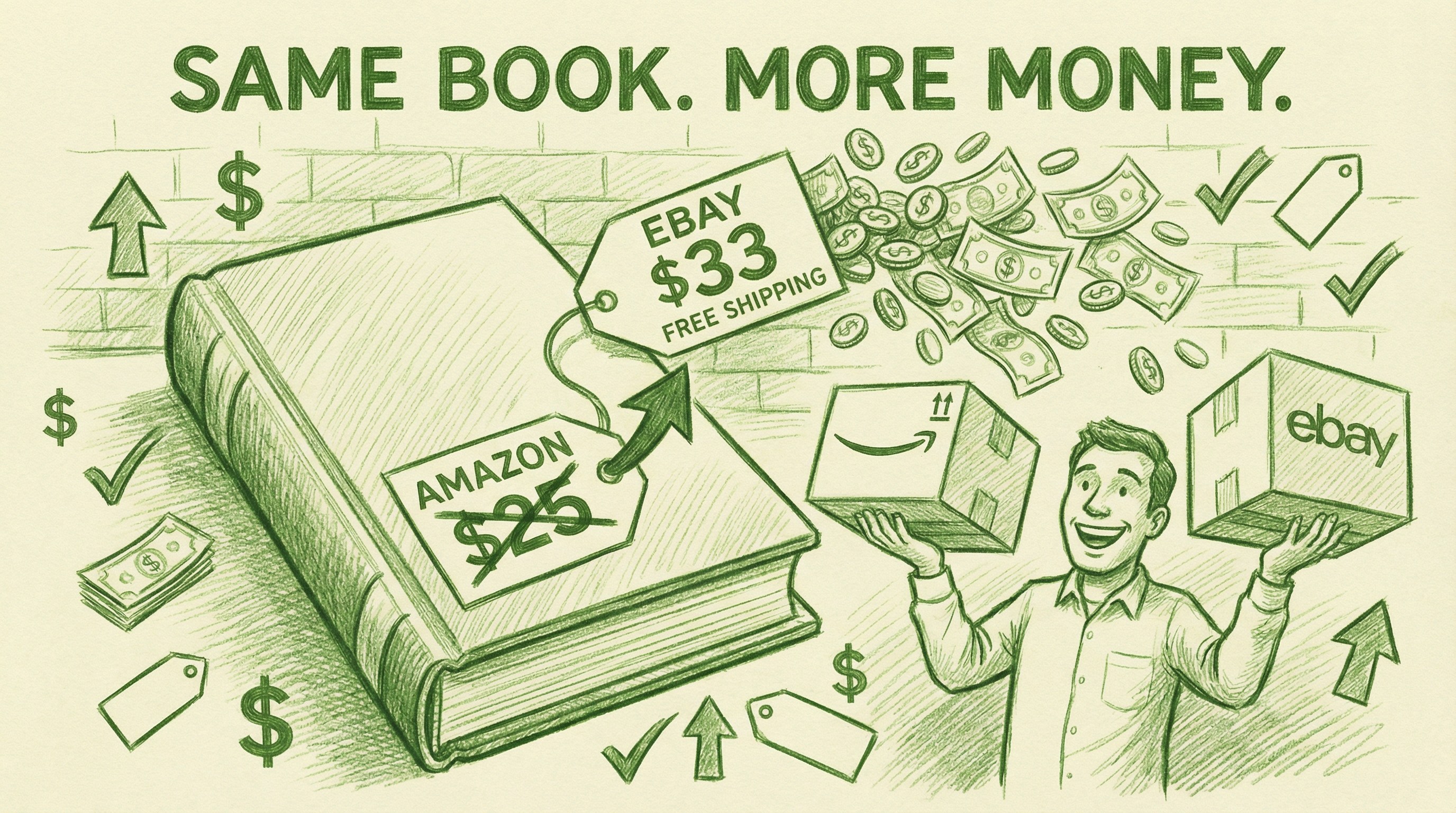
eBay doesn’t have this problem. There is no Buy Box. Every listing stands on its own — your price, your photos, your description. For niche books, collectibles, and out-of-print titles, there might be 1–2 other sellers on eBay instead of 15 on Amazon. Which means the market price on eBay often reflects what the item is actually worth, not what a price war drove it down to.
That’s the real case for cross-listing. It’s not just “sell in more places.” It’s that your Amazon price is artificially depressed by competition dynamics that don’t exist on eBay. Many of your items are worth more on eBay right now.
But eBay has different fees — and if you’re using Amazon’s Multi-Channel Fulfillment (MCF) to ship eBay orders, there’s a hefty premium on top. Price it wrong and you’ll give back all your margin without realizing it. Here’s the actual math so you know exactly what to charge.
The Short Answer
If you don’t want the full breakdown, here’s the recommendation:
If you use MCF (Amazon ships your eBay orders):
- Items under $15 on Amazon: don’t cross-list — the math doesn’t work
- Items $15–50: price at Amazon + $8
- Items $50+: price at Amazon + $10
If you ship MF (you ship it yourself):
- Items $10–25: price at Amazon + $5
- Items $25–50: price at Amazon + $7
- Items $50+: price at Amazon + $8
Always offer free shipping on eBay. More on that below.
Why eBay Pricing Is Tricky
On Amazon, your fees are straightforward: a 15% referral fee plus a fulfillment fee (around $3–5 for most standard-size items). On eBay, the percentage cut is similar: 15.3% for books and media, 13.6% for most other categories, plus a flat $0.40 per order.
Where it gets expensive is fulfillment. When your item sells on eBay and Amazon ships it via MCF, that fulfillment fee jumps from ~$3.79 (normal FBA) to ~$8.93 (MCF) for a typical 1-lb item. An extra $5+ per sale just for having Amazon ship it to an eBay buyer instead of an Amazon buyer.
Your eBay price needs to be higher than your Amazon price to cover that gap.

MCF Cross-Listing: The Actual Math
Here’s what really happens when a $25 book sells on Amazon vs. eBay:
Sold on Amazon (FBA):
- Sale price: $25.00
- Amazon referral fee (15%): −$3.75
- FBA fulfillment: −$3.79
- You keep: $17.46
Sold on eBay at $25 (same price) via MCF:
- Sale price: $25.00
- eBay fee (15.3%): −$3.83
- Per-order fee: −$0.40
- MCF fulfillment: −$8.93
- You keep: $11.85 ← $5.61 less than Amazon. Ouch.
Sold on eBay at $33 (Amazon + $8) via MCF:
- Sale price: $33.00
- eBay fee (15.3%): −$5.05
- Per-order fee: −$0.40
- MCF fulfillment: −$8.93
- You keep: $18.62 ← $1.16 more than Amazon. ✅
The break-even across price points is consistently around Amazon + $7. Amazon + $8 gives you about a dollar of buffer. Amazon + $10 gives you a real margin of $2.63–2.89 per sale.
| Amazon Price | Break-Even eBay Price | At Amazon +$5 | At Amazon +$8 | At Amazon +$10 |
|---|---|---|---|---|
| $15 | $21.59 (+$6.59) | −$1.35 | +$1.19 | +$2.89 |
| $25 | $31.63 (+$6.63) | −$1.38 | +$1.16 | +$2.86 |
| $50 | $56.72 (+$6.72) | −$1.45 | +$1.09 | +$2.78 |
| $75 | $81.81 (+$6.81) | −$1.53 | +$1.01 | +$2.70 |
| $100 | $106.89 (+$6.89) | −$1.61 | +$0.94 | +$2.63 |
If you’re selling non-book categories (toys, electronics, etc.), eBay’s fee drops to 13.6%, so break-even falls to around Amazon + $5–6.
Should you cross-list items under $15? Probably not via MCF. The math technically works — a $12 book priced at $22 on eBay nets you more — but a $22 eBay price for a $12 Amazon book looks absurd to buyers. Nobody’s buying it. Below $15, skip MCF cross-listing.
MF Cross-Listing: Different Math, Same Idea
If you’re shipping orders yourself (Merchant Fulfilled), you don’t pay the MCF premium. Your cost is actual postage: Media Mail for books (~$4), First Class for lighter items (~$5), Priority for heavier stuff (~$8–12).
There’s an important difference in how Amazon MF and eBay handle shipping. On Amazon MF, the buyer pays a separate shipping charge — so Amazon collects $28.99, takes their 15% on the item price, and passes the shipping portion back to you. The shipping essentially pays for itself.
On eBay with free shipping (which you should always offer), the buyer pays one price and you absorb the postage out of it. That’s the gap you’re closing with the markup.
Sold on Amazon (MF):
- Buyer pays: $25.00 + $3.99 shipping
- Amazon referral fee (15% of $25): −$3.75
- Postage (Media Mail): −$4.00
- You keep: $21.24
Sold on eBay at $30 (Amazon + $5), free shipping, you ship:
- Buyer pays: $30.00
- eBay fee (15.3%): −$4.59
- Per-order fee: −$0.40
- Postage (Media Mail): −$4.00
- You keep: $21.01 ← basically break-even ✅
| Amazon Price | Break-Even eBay Price | At Amazon +$5 | At Amazon +$7 |
|---|---|---|---|
| $15 | $20.24 (+$5.24) | −$0.20 | +$1.49 |
| $25 | $30.27 (+$5.27) | −$0.23 | +$1.46 |
| $50 | $55.36 (+$5.36) | −$0.31 | +$1.39 |
| $75 | $80.45 (+$5.45) | −$0.38 | +$1.31 |
Amazon + $5 is close to break-even for MF books. Amazon + $7 gives you a margin of ~$1.30–1.50 per sale.
Always Offer Free Shipping on eBay
eBay’s search algorithm (Cassini) heavily favors free shipping listings. You rank higher and convert more buyers. “$25 + $5 shipping” vs “$30 free shipping” is mathematically identical — eBay takes their percentage on shipping charges too — but free shipping gets you better placement in Best Match results, higher conversion (buyers hate paying shipping), and eligibility for eBay promotions and Top Rated Plus.
The markup already absorbs the shipping cost. Let the buyer see “Free shipping.”
For MCF: set handling time to 2–3 business days and turn on “blank box” packaging in your MCF settings so buyers don’t get an Amazon-branded package. For MF: set handling time to 1–2 business days and ship books via Media Mail.

Setting Up Your Pricing Rules
Rules are evaluated in order — first match wins — so put the highest price tier first.
MCF sellers:
| Rule | If Amazon price is… | Set eBay price to… |
|---|---|---|
| 1 | ≥ $50 | Amazon + $10 |
| 2 | ≥ $20 | Amazon + $8 |
| 3 | ≥ $15 | Amazon + $7 |
Don’t cross-list anything under $15 via MCF.
MF sellers:
| Rule | If Amazon price is… | Set eBay price to… |
|---|---|---|
| 1 | ≥ $50 | Amazon + $8 |
| 2 | ≥ $20 | Amazon + $7 |
| 3 | ≥ $10 | Amazon + $5 |
The Bottom Line
Your Amazon price is getting beaten down by 10 other sellers fighting over a Buy Box that nobody fully understands anymore. eBay doesn’t have that problem. Your listing is your listing — and for a lot of inventory, the market price on eBay is higher than what Amazon’s race to the bottom landed on.
The fee gap is real but the fix is simple. Amazon + $8 for MCF, Amazon + $5 for MF, free shipping on everything. Set your rules once and let it run.
Fee rates used: eBay FVF 15.3% (books/media) and 13.6% (most other categories) + $0.40/order. Amazon referral 15%. FBA fulfillment ~$3.79 (medium standard). MCF fulfillment ~$8.93 (large standard, 1-unit order, standard delivery). Media Mail ~$4.00. All figures are 2025–2026 rates and will vary by item size/weight. eBay Store subscribers may get slightly lower FVF rates.
AccelerList’s eBay cross-listing handles all of this automatically — set your pricing rules once and it calculates the right eBay price on every item. Try it free for 14 days.
Try AccelerList free for 14 days
See how many sales roll in. If you don't make at least $200 — just cancel. But if you're not signed up right now, that money is sitting there.
Start free trial →How to Price Your eBay Cross-Listings Without Losing Money (2026 Math)
If you’re only selling on Amazon right now, your prices are probably lower than they should be. And you’re probably right to feel that way. Caleb Roth’s Buy…

Amazon seller & Software Founder