If you are still pricing your FBA books 20-30% higher than Merchant Fulfilled offers and expecting to win the Buy Box, your inventory is likely gathering dust. The "Prime delivery speed" advantage has been flattened by Amazon’s 2026 algorithm updates. Today, a Like-New MF offer that is priced lower than FBA will win the Buy Box nearly 100% of the time.
To build a sustainable business in 2026, you cannot rely solely on $500 "treasure" finds or the low-margin grind of bulk pallets. The winning model is a hybrid approach targeting a $20–$40 Average Selling Price (ASP). Here is how to price that inventory for sustainable profit.
The 2026 Pricing Shock: The Prime Bump is Dead
For years, FBA sellers enjoyed a "pass" from the algorithm. You could price significantly higher than MF sellers because Amazon prioritized Prime delivery speed above almost everything else. That era is over.
Amazon’s current machine learning models prioritize Value and Condition. If an MF seller can deliver a "Like-New" book for $19.99, Amazon will not show the customer your FBA "Very Good" copy for $24.99. Even with the Prime badge, you are no longer insulated from the MF market floor. You must price against the entire market, not just other FBA sellers.
The $20 ASP Goal: The Hybrid Business Model
A scalable book business isn't built on outliers; it's built on range. You need a mix of high-velocity "bread and butter" books and high-margin specialty titles. This requires a two-pronged pricing and fulfillment strategy:
- FBA for Velocity: Send books to the warehouse if the margin can absorb the FBA fees and the buyer values speed (e.g., current textbooks, seasonal gifts, or books with a Sales Rank under 100k).
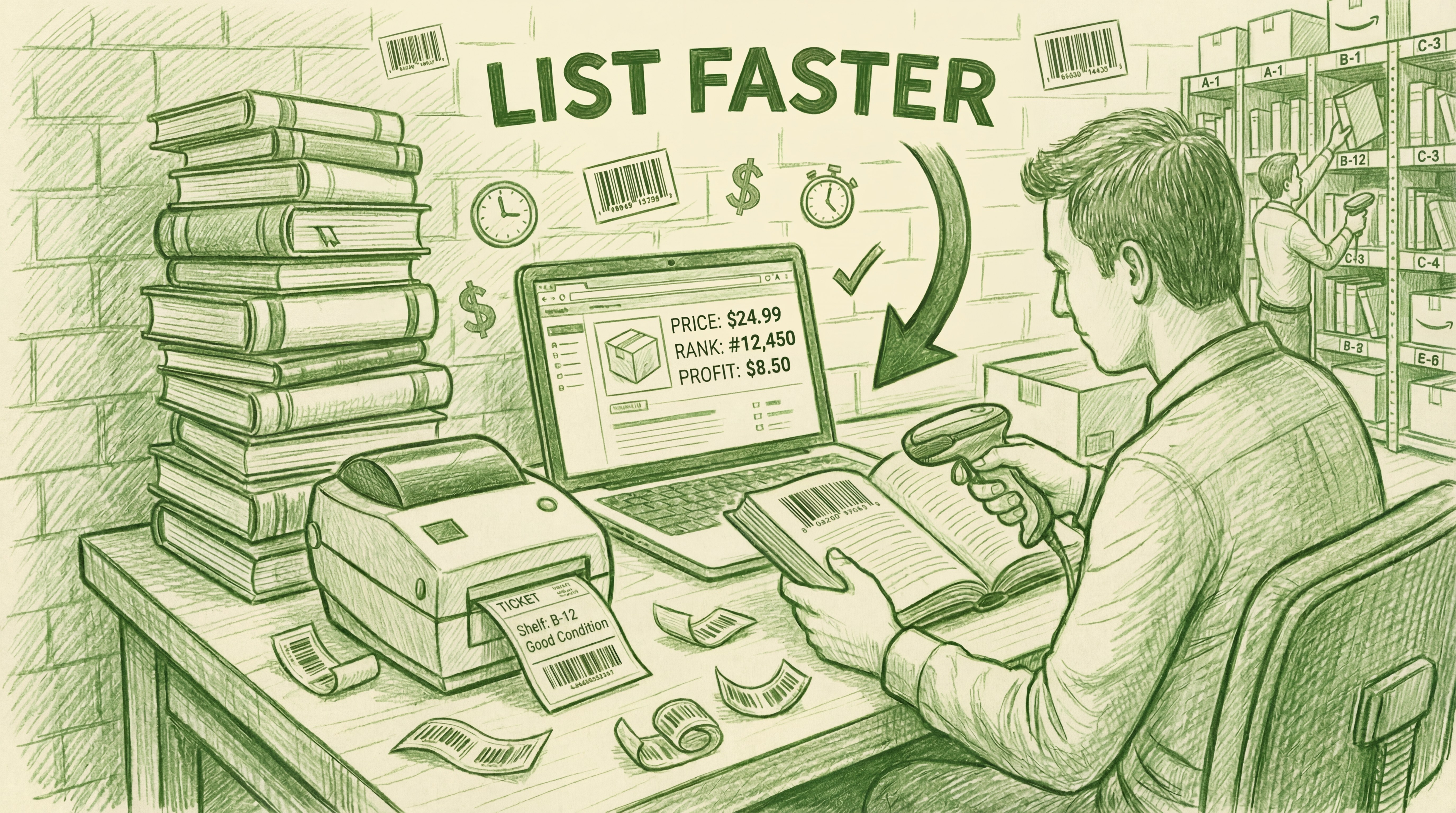
- MF for Margin: Fulfill books yourself when FBA fees (including the $1.80 closing fee and storage) would kill the profit. AccelerList is built to make this efficient with our ticket and shelf-run system, allowing you to stay competitive with the market floor while keeping more of the sale.
The "Initial Right Price" Rule
The most dangerous habit in pricing is the "Penny War." Automatically undercutting the lowest seller by $0.01 is a race to zero that wipes out the margin for everyone. Instead, use the Condition-Match strategy:
- Ignore the "Acceptable" Floor: Don't let a beat-up, water-damaged copy set your price.
- Match the REAL Competition: Match the lowest price in your condition grade (or higher) across both FBA and MF channels.
- The eBay Safety Valve: If the Amazon price is suppressed by high-volume sellers to the point where it’s not profitable, pivot. Cross-list to eBay where buyers pay a premium for visual transparency (photos) and manual descriptions.
Structural Velocity: Solving the Storage Problem
In a used media business, unlisted inventory is a liability. Every box of books in your garage is "dead capital" taking up physical and mental space. This leads to the Fast $3 Rule:
For lower-value "filler" inventory, take the fast sale. Clearing that shelf space so you can process your next $30 find is more valuable than waiting six months to squeeze out an extra $2 in profit. In 2026, flow is more important than the individual margin on low-ASP items.
The 90-Day Hand-off: Initial Price vs. Robots
We believe in human expertise for the most critical part of the process: the Initial Right Price. Use AccelerList to set a smart, market-based price at the moment of listing. Your best chance for a high-margin sale is in the first 30 days while your listing is "fresh."
However, if a book hasn't moved in 90 days, your initial thesis was likely wrong—the market has shifted or demand has dropped. That is when you bring in the robots. Hand those stagnant listings off to a third-party automated repricer to liquidate the item and recover your capital for new sourcing. AccelerList gets you live and profitable on day one; the repricer handles the "exit strategy" for slow movers.
Frequently Asked Questions
Why is my FBA book not winning the Buy Box?
Check the Merchant Fulfilled (MF) floor. If there is a "Like New" or "Very Good" MF offer priced lower than your FBA offer, Amazon's 2026 algorithm will almost always prefer the MF seller. You may need to lower your price to match the total market floor.
Should I always be the lowest price on Amazon?
Only if you need the physical storage space immediately. If the book has a healthy Sales Rank (high demand), it is often better to match the lowest price in your condition grade and wait for the "bottom-feeders" to sell out.
How do I manage a high-volume MF operation?
Success in MF requires a "no-touch" workflow. AccelerList helps you set up a professional MF operation using printable tickets that act as location markers and high-speed batch listing tools that eliminate manual data entry.
What is a "good" ASP for a small book seller?
Most sustainable hybrid operations aim for an ASP between $20 and $40. This allows enough margin to absorb fees and shipping costs while maintaining a high enough volume to keep the business growing.
Ready to price for profit? Start your 14-day free trial of AccelerList today and master the 2026 hybrid listing workflow.
How to Price Books on Amazon: The Reseller’s Guide
What is used book pricing in 2026? It is the strategic process of setting a list price that balances immediate Buy Box capture with long-term margin protection. In…

Amazon seller & Software Founder