Amazon Fees for FBA: What does it mean for booksellers – 2024

image
Amazon Fees for FBA: What does it mean for booksellers – 2024

As booksellers, we know success on Amazon relies on understanding and adapting to its ever-changing environment. Recently, two significant updates announced by Amazon - the introduction of Inventory Placement fees and adjustments to FBA fulfillment fees - require our attention.

Let's break down both sets of changes and explore their impact on our businesses:

Inventory Placement Fees: New Costs and Strategic Solutions

Effective March 1st, 2024, Amazon is introducing new Inventory Placement fees to distribute inventory closer to customers. The fees will be distributed across two of the three Inbound Placement options. The third Inbound Placement option is being called Amazon Optimized Shipment Splits and will have no fees but could generate 4+ potential splits when creating batches.

Here are the three new Inbound Placement options to sellers:

  1. Minimal Shipment Splits
  2. Partial Shipment Splits
  3. Amazon Optimized Shipment Splits
a view of these options from the Amazon Revenue Calculator

For book sellers, this translates to an average of $0.27 per unit for standard-sized books and $1.58 for bulky ones.

While Inventory Placement fees introduce new costs, the good news is:

  • FBA fulfillment fees are decreasing! Standard-sized book fulfillment fees will drop by $0.20 per unit, and large bulky ones will see a significant $0.61 decrease starting April 15th, 2024.
  • Books under $10 still enjoy an additional $0.77 discount.

So if the average book sold on Amazon's marketplace by FBA sellers fits the standard size (15″ x 12″ x 0.75″) then sellers on average should only see an $0.07 increase in fees per book. That's not bad at all considering historial fee increases from Amazon are typically in the 10-15% range.

Single Book Example

Let's take a single book example and break down the pricing with the new fees.

This book falls within the standard size for Amazon and thus here is the Inbound Placement Fee calculation that comes directly from Amazon's Rev Calculator:

According to Amazon, by default, sellers will be opted into the Partial Shipment Splits option unless they change this setting within Seller Central.

It is our opinion, that for book sellers, you will want to stick with this default placement option because it is the happy medium between the other two options in terms of costs and headaches.

Remember: Amazon provides a calculator to estimate fees for specific ASINs and units. Use it to make informed decisions.

While Inventory Placement fees introduce new costs, the good news is:

  • FBA fulfillment fees are decreasing! Standard-sized book fulfillment fees will drop by $0.20 per unit, and large bulky ones will see a significant $0.61 decrease starting April 15th, 2024.
  • Books under $10 still enjoy an additional $0.77 discount.

Conclusion:

While adjustments are occurring, it's crucial to remember that Amazon remains committed to partnering with sellers for mutual success. By understanding the fee updates, implementing strategic cost-saving measures, and exploring new program opportunities, you can continue to thrive in the evolving Amazon landscape. Embrace the change, analyze its impact on your business, and adapt your strategies for continued success.

Seller Articles

View all

FBA vs Merchant Fulfilled for Books: Which Should…

FBA vs Merchant Fulfilled for books: FBA (Fulfilled by Amazon) means you ship…

The Amazon FBA Exit Strategy: How to Switch…

Executive Summary: An Amazon FBA exit strategy is a shift from using Amazon's…

What Is Batch Listing? How Amazon Book Sellers…

What is batch listing? Batch listing is the workflow of processing a group…

FBA vs Merchant Fulfilled for Books — Which…

FBA vs. Merchant Fulfilled: Which actually makes more money in 2026? While FBA…

How to Price Books on Amazon: The Reseller’s…

What is used book pricing in 2026? It is the strategic process of…

How to Sell Books on Amazon in 2026 (The Complete Guide)

image
How to Sell Books on Amazon in 2026 (The Complete Guide)

What is selling books on Amazon in 2026? It is the strategic business of sourcing, listing, and fulfilling new or used media through Amazon’s marketplace. In 2026, success is defined by a hybrid workflow that prioritizes high Average Selling Prices (ASP) and premium condition grades over the old "low-margin bulk" models.

If you are still following bookselling advice from 2022, you are likely working harder for less money. The 2026 marketplace has undergone a fundamental shift. The "Prime bump"—where Amazon arbitrarily favored FBA sellers—has been flattened. The algorithm now prioritizes a triad of Price, Speed, and Premium Condition.

Winning in 2026 means moving away from the "Logistics of Trash"—driving around town to move hundreds of $10 books for a $2 margin. To build a sustainable business, you need a high-fidelity workflow that targets a $20–$40 ASP, leverages free storage at home for high-value gems, and uses professional tools to scale without hiring a warehouse team.

The 2026 Reality: Why the "Old Way" is Dead

The "Feed the Beast" model—sourcing massive volume at low margins—is a burnout trap for small sellers. In 2026, the $1.80 media closing fee and rising inbound shipping costs have made low-value FBA inventory effectively unprofitable. If you are paying FBA fees but cannot price 20% higher than Merchant Fulfilled (MF) offers, you are subsidizing Amazon’s logistics with your own profit.

The new goal is Structural Velocity. You want a business where your inventory is high-value enough to justify your time, and your workflow is fast enough to keep your "dead capital" (unlisted boxes) at zero.

Sourcing Strategy: Filtering for Gold

A sustainable business is built on range, not outliers. You can't find a $500 book every day, but you can find five $40 books. Your sourcing should focus on:

  • Free Inventory via Book Pickups: Run a local pickup or buyback program to get the volume you need without the upfront capital risk. Keep the top 5% that are high-value gems and recycle the rest.
  • Aggressive Filtering: If a book doesn't have a high list price or a solid historical comp on Keepa, leave it. Don't lug "maybe" books home.
  • Long-Tail Gems: Many of the most profitable books in 2026 have no current offers on Amazon. Use historical data to identify books that sell for $100+ once or twice a year—those are your MF "retirement" fund.

Fulfillment Strategy: FBA for Velocity, MF for Margin

The most important decision you make at the scanner is routing. Most small sellers should follow the 5% FBA Rule:

Only send a book to Amazon FBA if it is a "Sure Thing" (Sales Rank under 50k) or a seasonal peak (Textbooks). For everything else—especially long-tail books over $50—Merchant Fulfillment (MF) is the superior choice. Your spare room provides free storage, and you avoid the monthly fee drain while waiting for the right buyer.

Read the full FBA vs. MF Profit Breakdown

Grading for the Buy Box: Condition is the New Prime

In 2026, "Like New" is the prerequisite for holding the Buy Box on competitive listings. Because Amazon prioritizes Negative Customer Experience (NCX) prevention, they favor higher-condition items that are less likely to be returned.

Accurate grading is your only protection against "Used-Sold-As-New" fraud flags. A professional workflow doesn't skip the grading step; it makes it high-fidelity through pre-sorting and one-tap condition macros.

Read the 2026 Book Grading Guide

Pricing for Sustainable Profit

Stop the $0.01 undercutting. Your goal is to match the Total Market Floor (the lowest price in your condition grade, whether it's FBA or MF). If the Amazon price is suppressed by bottom-feeders, use the eBay Safety Valve.

Cross-listing to eBay allows you to command a premium for high-value books because eBay buyers pay for the transparency of your actual photos and detailed notes. AccelerList shows you real-time eBay "Median and Range" data inside your batch so you can set an eBay-specific price that maximizes your ROI.

Read the 2026 Pricing Strategy Guide

Scaling the Workflow: AccelerList as Your Backbone

At low volume, manual listing is fine. At scale, the keyboard is your bottleneck. AccelerList is built to remove that ceiling:

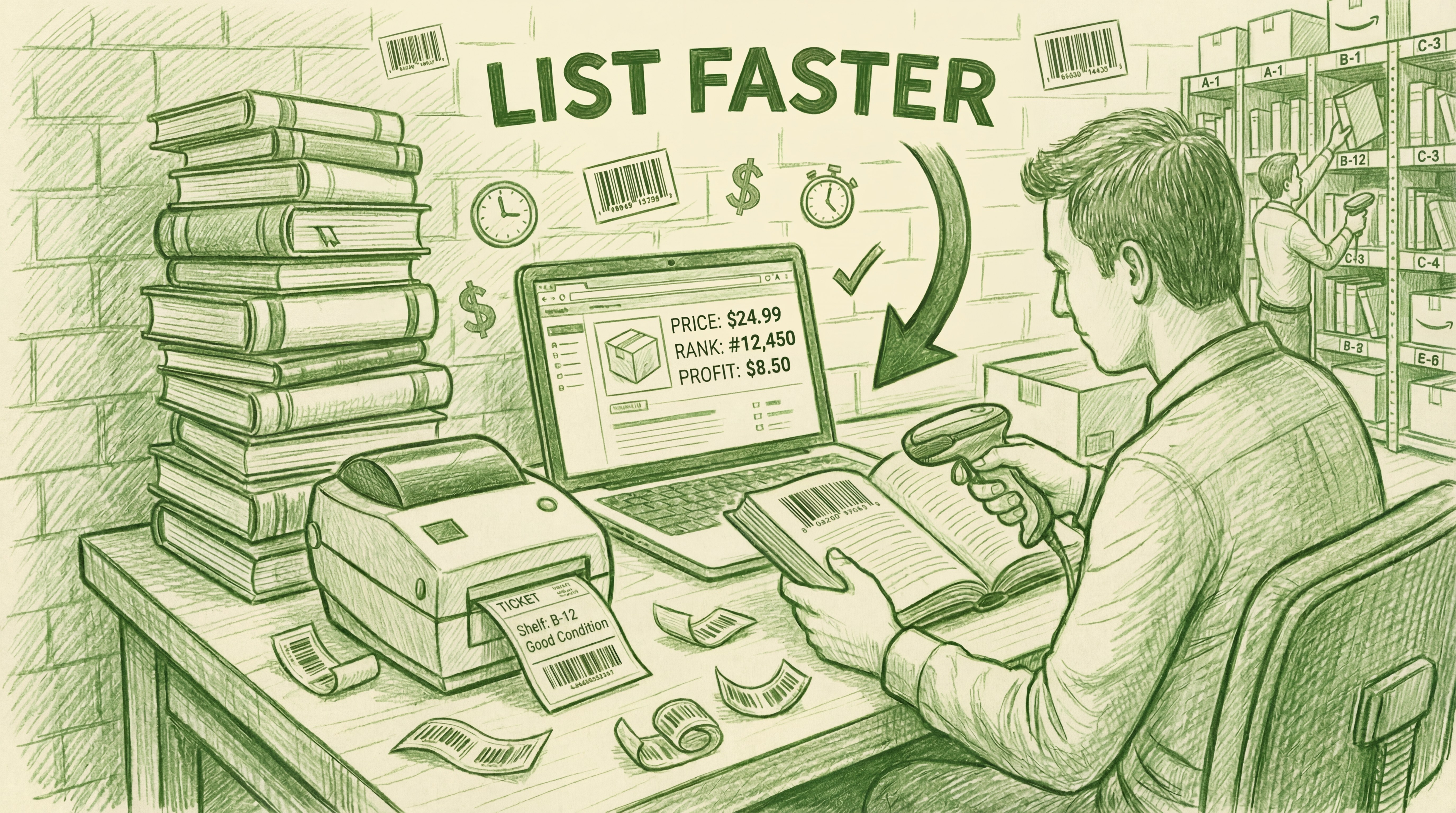
  • Rapid Listing: Use a background queue system to scan books faster than the Amazon API can process them. No waiting for page loads.
  • The MF System: Use printable tickets that act as shelf location markers. Turn any room into a professional fulfillment center where you can find any book in 10 seconds.
  • Multi-Channel Power: One scan lists your book on Amazon and eBay simultaneously, reaching two completely different buyer pools with zero extra work.

See how Batch Listing scales your business


Frequently Asked Questions

Is selling books on Amazon still profitable in 2026?

Yes, but the model has changed. The profit is in the $20–$40 ASP range and high-value long-tail items. The old "high-volume, low-margin" FBA model is no longer viable for most small sellers.

Do I need a warehouse to sell books?

No. In 2026, the "Spare Room MF" model is often more profitable than a warehouse-based FBA model for individual sellers because it eliminates fixed overhead and storage fees.

What is the best way to handle eBay orders?

For FBA inventory, AccelerList routes eBay orders through Amazon’s Multi-Channel Fulfillment (MCF). For MF inventory, you fulfill it yourself. The key is using one system to manage both channels so you never oversell.

How do I start with $100?

Start with Merchant Fulfillment. Spend $50 on a basic USB scanner and $50 on your first thrift store or library sale haul. Use AccelerList to list them MF and reinvest your profits into higher-value inventory.

Ready to own the 2026 marketplace? Start your 14-day free trial of AccelerList today and build a bookselling business that actually scales.

Seller Articles

View all

FBA vs Merchant Fulfilled for Books: Which Should…

FBA vs Merchant Fulfilled for books: FBA (Fulfilled by Amazon) means you ship…

The Amazon FBA Exit Strategy: How to Switch…

Executive Summary: An Amazon FBA exit strategy is a shift from using Amazon's…

What Is Batch Listing? How Amazon Book Sellers…

What is batch listing? Batch listing is the workflow of processing a group…

FBA vs Merchant Fulfilled for Books — Which…

FBA vs. Merchant Fulfilled: Which actually makes more money in 2026? While FBA…

How to Price Books on Amazon: The Reseller’s…

What is used book pricing in 2026? It is the strategic process of…